Dwarf, orc and dragon names: sounds, clan names and epithets
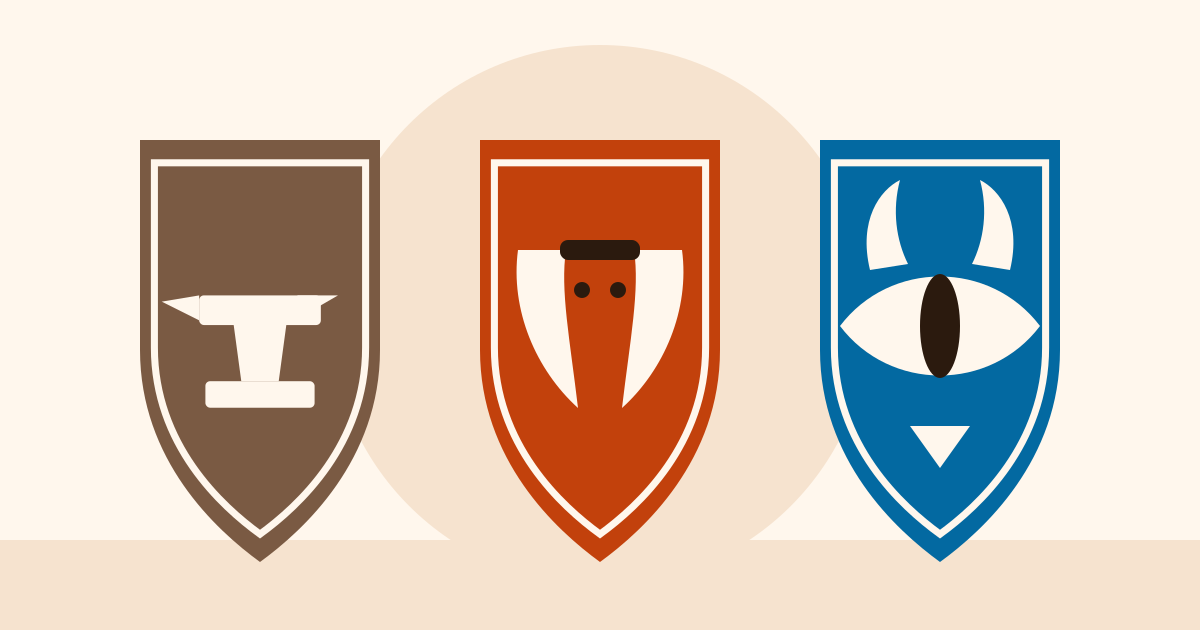
Dwarf, orc and dragon names work when each race has its own sound, not just its own spelling. Dwarves get hard stops and short closed syllables, orcs get back vowels and snarled endings, and dragons get long, hissing names with a title attached. Below is the palette for each, the way I build clan names and epithets, and eight examples per race.
A quick check before anything else: read three names aloud with your eyes shut. If you can tell the race from the sound alone, the palette works. If you cannot, the names are decorated English and players will forget them by the next session.
Three palettes at a glance
| Dwarf | Orc | Dragon | |
|---|---|---|---|
| Core sounds | b, d, g, k, t, th, h, m, n, r, st, br, dr, gr, kr | g, k, z, r, sh, b, d, m, n, gr, kr, br, dr | th, r, s, v, k, z, x, sk, kr, dr, gr |
| Vowels | a, o, u (i and e less often) | a, o, u (i rare) | a, i, y (o and u less often) |
| Shape | CVC, heavy; mostly 2 syllables | CVC or CV; 1 or 2 syllables, sometimes 3 | CVC heavy with some CV; 2 or 3 syllables, sometimes 4 |
| Codas | k, g, r, n, m, d, rn, rk | g, k, z, sh, r, t | x, th, r, s, n, k |
| Gender ending | male closed (-in, -ar, -ur, -or, -grim), female mostly open (-a, -ra) plus -is, -dis, -ild, -ryn | male -ug, -ak, -osh, -uk, -ar; female -a, -ra, -ka, -ga, -ush, -ish | male -ax, -ion, -yx, -or, -oth; female -ira, -yssa, -ith, -ara, -yx |
| Wrapper | lineage (son or daughter of) or a clan | earned epithet | title |
Dwarf names: stops, closed syllables and lineage
Dwarves live in stone and their names should sound like it. I build them from stops (b, d, g, k, t) and the clusters br, dr, gr, kr, with dark vowels a, o, u and closed syllables. Stops are the least vowel-like sounds, so they cut the air instead of carrying it, and that is the effect you want. Male endings are closed, such as -in, -ar, -ur, -or or -grim; female endings are mostly open, -a and -ra, with -is, -dis, -ild and -ryn as the closed exceptions.
Eight dwarf names from this palette, straight out of the generator: Thadin, Nadrar, Gruktor, Borgin, Brugrin (male) and Doga, Dadis, Brild (female).
Clan names for dwarves
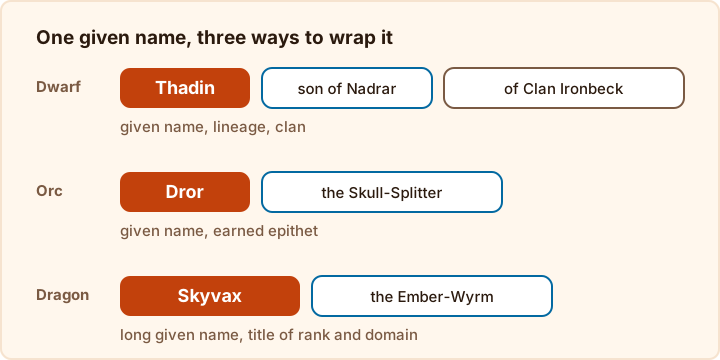
A dwarf clan name works best as a plain English compound that names the craft or the land: Ironbeck, Copperhelm, Silverhold, Stonefist. The generator builds them from a metal, stone or craft word (iron, stone, flint, copper, silver, coal, anvil, hammer, deep, granite, forge, ember, gold, bronze) and a dwarven thing (beck, garth, helm, fist, shield, beard, hold, vein, mantle, hammer). The element -beck is a real Old Norse and Old English word for a stream, and it fits a mining family that works beside a creek. The tool gives each dwarf either a line of descent, as in Gild, daughter of Grakin, or a clan, as in Kis of Clan Emberbeard. If you want both, combine them by hand: Thadin, son of Nadrar, of Clan Ironbeck is ready for a character sheet. Keep the clan in plain English and the given names in the dwarf palette; the contrast tells a reader that the clan is the family brand and the given name is the person.
Orc names: back vowels, short names and earned epithets
Orc names are short and blunt: one or two syllables, back vowels a, o, u, and consonants g, k, z, r, sh. I allow codas g, k, z, sh, r and t because they end a name with a snarl. Female names often end in -a, -ra, -ka, -ga, -ush or -ish. Eight orc names from the palette: Ruggar, Dror, Shog, Gushug, Groshak, Zush (male) and Nagra, Krozga (female).
Epithets that have to be earned
In my games orcs rarely get a family tree, so I give them a deed: Razmosh the Bone-Crusher, Gazuk the Ash-Gnawer, Modush the Skull-Eater. The rule I use, and the one the generator follows, is one noun (skull, bone, tusk, shield, wall, gate, stone, iron, ash, ember, horn, root, ox) and one doer word (splitter, breaker, gnawer, crusher, biter, burner, taker, hewer, smasher, eater, ripper), joined by a hyphen, and the epithet must be something a player can picture. If the character changes, the epithet changes: a warlord can lose a name by losing a fight.
Dragon names: long, hissing and titled
A dragon is old, so its name is long. I use two or three syllables, sibilants and fricatives (s, th, x, z, v) and the vowels a, i, y (o and u less often), with a final -ax, -oth, -ion or -yx for males and -ira, -yssa, -ith or -ara for females. The sounds stretch when spoken, which suits a creature that speaks slowly. Eight dragon names: Skyvax, Karxion, Driskor, Drorsikoth (male) and Thara, Krasith, Syssa, Grozira (female).
Titles for dragons
A title does the work an epithet does for an orc, but it states rank and domain: Skyvax the Ember-Wyrm, Grysthyx the Salt-Wyrm, Vathkor the Cinder-Crown. The generator pairs an element or material word (ember, ash, storm, frost, night, gold, iron, cinder, salt, bone, sky, thunder, venom, glass, dusk) with a creature word (wyrm, drake, wing, maw, scale, tongue, claw, fang, crown, heart). Pick the title from the dragon's element or from what it did, and keep it to two words so a player can say it in one breath.
Avoiding a famous name by one letter
Short, hard names are where accidental copies happen, because the sounds available are so few. Smoug is one letter from Smaug, Drizzit is one from Drizzt, and Gandolf is one from Gandalf. The test I use is the edit distance: count the single-letter changes needed to turn your name into the famous one. One edit is a copy, and for names of seven letters or more I treat two edits as too close. Thalindor is seven edits from Gandalf, so it is safe. The fantasy name generator flags these automatically, checking against twenty well-known characters and 23 famous weapons and places, and it never outputs an exact match; by hand, simply change a vowel and a consonant.
Build a race name in four steps
- Choose the mood word (hard, snarled, hissing) and take 8 to 13 consonant units that fit it.
- Choose 3 vowels, dark for dwarves and orcs, open for dragons.
- Set the shape and the ending from the table above, and reject triple letters, three vowels in a row and four consonants in a row.
- Add the wrapper: lineage and clan for dwarves, a deed for orcs, a title for dragons.
The general method behind these palettes is in how to make fantasy names sound like one language, and the same ideas for maps are in how to name fantasy towns and kingdoms. Clan names such as Ironbeck can double as town names.
Things people ask
How do I make a dwarf name sound like a dwarf?
Use stops and short clusters (b, d, g, k, t, br, dr, gr, kr), dark vowels a, o and u, and closed syllables. Male endings are closed (-in, -ar, -ur, -grim), female endings mostly open (-a, -ra), with -dis, -ild and -ryn as closed exceptions.
What makes a good orc name?
One or two short syllables, back vowels and snarled consonants such as g, k, z, sh. Add an epithet that records a deed, like the Skull-Splitter.
How do I name a dragon?
Give it a long name of two or three syllables with sibilants and fricatives, then a title: Skyvax the Ember-Wyrm.
How do I make a dwarf clan name?
Use a plain compound of a metal or stone word and a dwarven thing, for example Ironbeck, Copperhelm or Stonefist, and add the lineage as son or daughter of.
Could my generated name be too close to a famous one?
It can. A name one letter away from a famous character reads as a copy. Compare it with the famous name, and change a vowel and a consonant if it is that close.