Fantasy town and kingdom names from real place-name elements
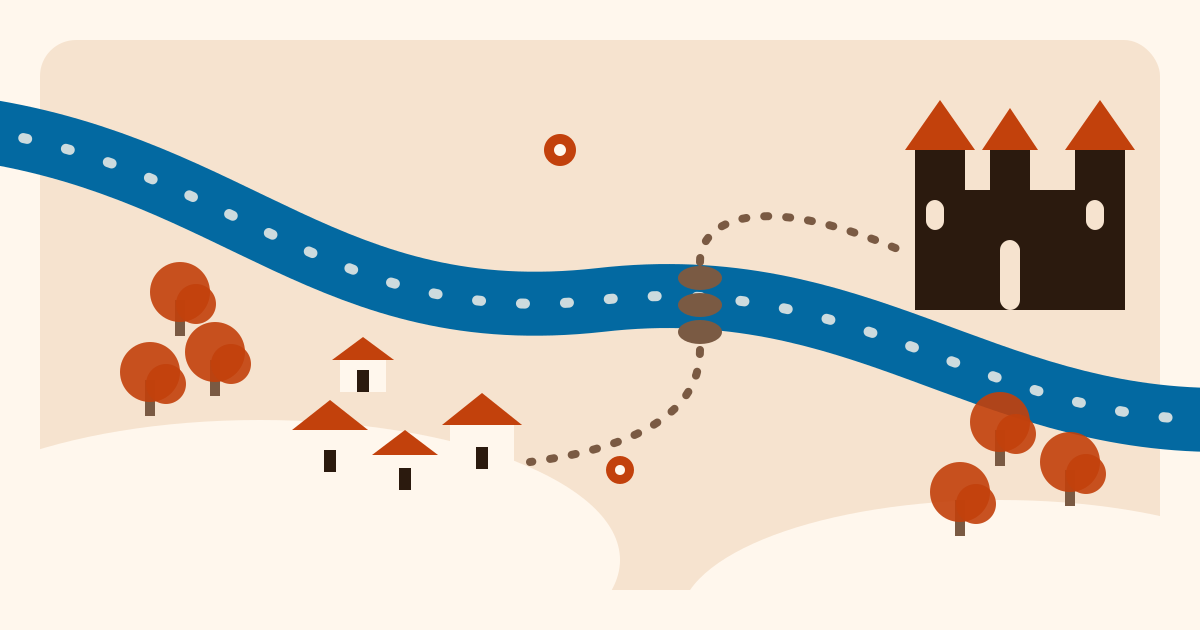
Fantasy town names that feel real borrow the way real maps work: every name says what the place is, using one small set of endings. Ashford is a crossing by ash trees, Coldkeld is a cold spring, Ravenholm is an island with ravens. Below are the real elements, what they mean and how to keep a whole kingdom consistent.
The mistake I see most in homemade maps is a town called Shadowhaven that sits in the middle of a plain with no shadow and no haven. Real names describe a place, so pick the feature first and the name second.
How real town names are built
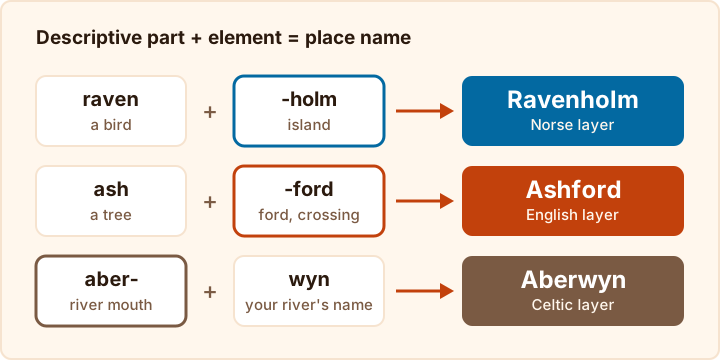
Many English, Scottish and Welsh place names are compounds: a descriptive part (a tree, an animal, a colour, an owner, a trade) and a generic element for the kind of place. The elements below are read from the Wikipedia list of generic forms in place names of the UK and Ireland, and the glosses are exactly the ones the fantasy name generator prints under every place name, with the source language on hover.
Place-name elements and what they mean
| Layer | Element | Meaning | Example |
|---|---|---|---|
| English | -ham | farm, homestead, settlement | Oakham |
| English | -ton | settlement (farmstead) | Stoneton |
| English | -ford | ford, crossing | Ashford |
| English | -ley / -leigh | woodland clearing | Elmley |
| English | -stead | place, enclosed pasture | Hollystead |
| English | -field | open land, a forest clearing | Barrowfield |
| English | -minster | large church, monastery | Greyminster |
| English | -den | valley (dene) | Wolfden |
| English | -shaw | a wood, a thicket | Birchshaw |
| English | -hurst | wooded hill | Oakhurst |
| English | -mere | lake, pool | Swanmere |
| English | -pool | harbour | Greypool |
| English | -port | port, harbour, landing-ground | Saltport |
| English | -stow | (holy) place of assembly | Kingstow |
| English | -mouth | mouth of a river, bay | Saltmouth |
| English | -burgh / -bury / -borough | fortified enclosure | Ravensburgh |
| Roman-origin | -chester / -caster | camp, fortification of Roman origin | Greycaster |
| Norse | -by | settlement, village | Ashby |
| Norse | -keld | spring | Coldkeld |
| Norse | -beck | stream | Ironbeck |
| Norse | -dale | valley | Thorndale |
| Norse | -holm | island (also holly) | Ravenholm |
| Norse | -garth | enclosure, small summit or ridge | Applegarth |
| Celtic | aber- | mouth of a river, confluence | Aberwyn |
| Celtic | inver- | mouth of a river, confluence, meeting of waters | Inverlochan |
| Celtic | llan- | church, churchyard, village with a church | Llanmor |
| Celtic | kil- | monastic cell, church | Kilbrae |
| Celtic | -combe | valley | Ashcombe |
| Celtic | pen- | head (headland or hill), top, far end | Penhallow |
| Celtic | bally- | farm, homestead (also mouth, approach, ford-mouth) | Ballycrane |
| Celtic | -more | large, great | Lochmore |
The layers matter. -by is Old Norse and -ham is Old English, so a stretch of map that holds both reads as a country settled by two peoples, which is how real Britain looks. Some elements sit in two languages: -ford is Old English and Welsh, -dale Old English and Old Norse. I treat those as bridge elements that a border region can share; the generator lets -dale, -holm and -beck appear in both its English and its Norse set, and the Celtic set shares -ford with the English one and -garth with the Norse one.
Name a town in five steps
- Pick the feature. Crossing, spring, valley, clearing, river mouth, fort, church. If you cannot name a feature, the town is not ready for a name.
- Pick the region's layer. English, Norse or Celtic (the generator adds Mixed for a border country). One region, one layer.
- Pick the element that means the feature in that layer: a crossing is -ford, a spring is -keld, a river mouth is aber- or inver-.
- Add the descriptive part: a tree, an animal, a colour, a trade or an owner. Ash, raven, grey, salt, iron.
- Say it aloud, then check that neither piece contradicts the map.
Ten invented names and what they mean
| Name | Built from | What the town is |
|---|---|---|
| Ashford | ash + -ford | a crossing beside an ash tree |
| Ravenholm | raven + -holm | an island where ravens nest |
| Thorndale | thorn + -dale | a valley full of thorn scrub |
| Coldkeld | cold + -keld | a settlement round a cold spring |
| Ironbeck | iron + -beck | a mining stream that runs rust red |
| Greycaster | grey + -caster | a fort left by an older empire |
| Elmley | elm + -ley | a clearing cut in an elm wood |
| Saltmouth | salt + -mouth | a harbour where a river meets the sea |
| Aberwyn | aber- + an invented river name | a town at a river mouth |
| Penhallow | pen- + an invented word | a town on a headland or hill top |
The descriptive part means whatever the English word says. For Aberwyn and Penhallow I treat the second part as a word of your own world: only aber- and pen- carry a real meaning, and the rest is yours to define. Say that plainly when a player asks what Aberwyn means.
One region, one language layer
This is the rule that makes a map believable. In a Norse-flavoured valley I use -by, -keld, -beck, -dale, -holm; in the farmland below it, -ham, -ton, -ley, -ford; in the western hills, aber-, llan-, pen-. A map with Ashby, Coldkeld and Ironbeck in the north, Elmley and Oakham in the middle and Aberwyn and Penhallow in the west looks like a country settled in layers. A town called Llanby, half Welsh and half Norse, looks like a mistake.
Kingdom names
A kingdom is a bigger and older thing than a town, so I name it after something that does not change: the people, the main river or the founder. The pattern is a name plus a generic word of your choice, such as land, march, reach or realm. Those four words are my own habit, not elements from the list above. Examples: Swanmere Reach (a lake kingdom), Ironbeck March (a border country with a mining stream), Elmley Realm (a woodland kingdom). The generator's kingdom mode goes the other way round and writes the rank first, as in Kingdom of Ravendale or Realm of Copperholm, using the same elements. Give the capital a different, plainer name than the kingdom, and use the same layer for both.
Keeping a whole map consistent
- Write the layer for each region on the map margin before you name anything.
- Keep a short list of descriptive parts per region (tree, beast, colour) and reuse them: three towns with ash in the name tell a reader that ash grows there.
- Let one element carry one meaning. If -holm is an island in one place and a hill in another, readers stop trusting the map.
- Do not mix layers inside one name unless the story explains it.
- Check that names are easy to say; five syllables on a table map is too many.
For the same sound-first thinking applied to people, read how to make fantasy names sound like one language and how dwarf, orc and dragon names differ. The place modes in the fantasy name generator (kingdom, town or city, village, forest, mountain and river) use exactly the elements and glosses in the table above, one region language at a time.
Things people ask
How do I name a fantasy town?
Pick what the place is (a crossing, a spring, a valley, a fort), choose the element that means it in one language layer, and add a descriptive part such as a tree, an animal or a colour. Ashford is ash plus ford.
What does -by mean in a place name?
It is an Old Norse element for a settlement or village. It is used at the end of a name, as in Ashby.
What do aber- and inver- mean?
Both mean the mouth of a river or a confluence. Aber- is Welsh, Cumbric, Pictish and Cornish; inver- is Scots Gaelic and Irish. Use one or the other in a region, not both.
How do I name a kingdom?
Name it after something lasting: the people, a river or a founder, plus a word like land, march or reach. Keep the capital's name plainer and in the same language layer.
Can I mix Norse and Celtic endings on one map?
Yes, in different regions. A border where two peoples met is a good reason, but avoid combining both in one name.