Fantasy names that sound like one language: a sound palette in 5 steps

Fantasy names stop sounding like a pile of random syllables the moment every name of one people obeys the same small set of sound rules. That set is a sound palette: a few letters, a few syllable shapes, some endings. Five steps build one in about twenty minutes.
My test: I write three names for one village and ask a player which does not belong. Kelvira, Brokgar and Zhu'xal fail it at once; Tavir, Tesron and Milvira pass, because they share letters, shapes and endings.
Why mixed names clash
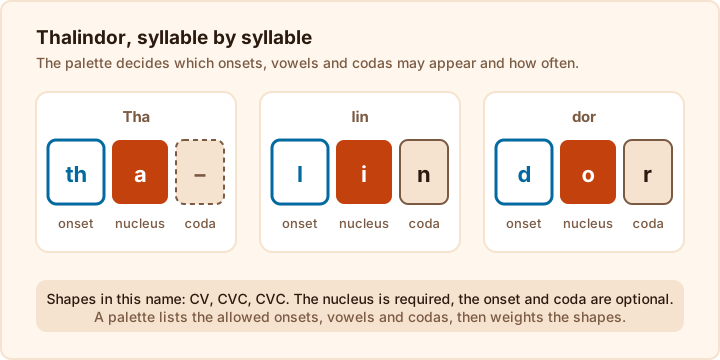
Linguists call the rules about allowed sound combinations phonotactics. A syllable has an onset (optional), a nucleus (required, usually a vowel) and a coda (optional). English lets an onset hold up to three consonants, as in strap, and forbids names that start with ng-.
A fragment-gluing generator ignores all of that. It picks Brok from one list and ielle from another, and the seam produces something no single language would. A palette chooses the sounds first and lets the names fall out. The Language Construction Kit gives the same advice for whole languages: build the sound system first, the words after.
The sound palette in five steps
- Pick the letters. Choose the consonant units and vowels your people use.
- Pick the syllable shapes. Decide how often a syllable is open (CV) or closed (CVC).
- Set what may start and end a syllable. Allowed onsets, allowed codas.
- Choose endings. Gender, rank or clan marked by the last syllable.
- Test it aloud. Reject what trips the tongue and keep a word list.
Step 1: Pick 8 to 15 consonant units and 3 to 5 vowels
A consonant unit is a letter or a digraph that you treat as one sound: th, sh, kh. For a full people I use 10 to 15 units. The tables below use 8 so that you can see the whole palette at once. Start small: the fewer letters, the faster a reader senses the pattern.
| Part | Choice |
|---|---|
| Consonant units (8) | l, r, n, s, t, v, m, th |
| Vowels (4) | a, e, i, o |
| Syllable shapes | CV and CVC, weighted 3 to 2 in favour of CV |
| Codas allowed | n, r, l, s only |
| Male ending | a closed syllable ending in n or r (-an, -or, -ir) |
| Female ending | an open syllable ending in a or e (-la, -ra, -ne) |
| Join rule | no doubled letter where two syllables meet |
The letters set the mood. Liquids and nasals (l, r, n, m) read as soft; stops and hard clusters (k, g, d, br, kr) read as heavy. I never mix both moods inside one culture.
Step 2: Choose syllable shapes and weight them
Shapes are written with C for a consonant and V for a vowel: CV (ta), CVC (tan), CCV (tra), VC (an). The weights matter more than the list. Conlang word generators such as Gen let you set a dropoff that makes short words more likely, because natural-looking vocabularies are dominated by one- and two-syllable words. For names I copy that: most are two syllables, a few three.
Open syllables (CV) sound lyrical, closed ones (CVC) with stops sound blunt, and shifting the weight is the quickest way to move a culture along that scale.
Step 3: Say what may start and end a syllable
Sounds line up by sonority, roughly how open and vowel-like they are. Sonority peaks at the vowel and falls away on both sides, which is why slips is possible and lsips is not. The practical result: clusters such as tr, bl, st can start a syllable, and clusters such as rt, lb can end one but sound wrong at the start. If you allow a cluster, put it only on the side where it works.
Write the allowed onsets and codas as two short lists. My mini-palette allows no cluster inside a syllable, which is why every name is easy to say. A mountain palette might allow br, dr, gr, kr as onsets and rk, rg, rn as codas, and then it needs nothing else to sound like a mountain.
Step 4: Choose endings for gender and rank
The last syllable is the cheapest signal you have. Readers learn an ending after two or three names and use it to sort the cast. I keep male and female endings different in kind, not only in letter: closed against open, as in the table above. Rank can work the same way. Apply the rule to the whole culture; an ending on one name in ten reads as a mistake.
Step 5: Test it aloud and keep a word list
I say every name three times at table speed before it goes on the map. If a player replaces it with a nickname within a minute, the name is too long or too clumsy. Then I check the joins:
- No three identical letters in a row, and no run of three vowel units (pairs such as ae, ai, ou count as one).
- No run of four consonant units, counting th and sh as one.
- No two main characters sharing an initial letter, a length and an ending (Aron, Arin, Aran is a trap).
- No name one letter away from a famous one: Gandolf is a single edit from Gandalf.
Keep every accepted name in a plain list; later you can reuse an old name as a family name, a hill or a ship.
A worked example: how many names does the mini-palette give?
With 8 consonant units and 4 vowels there are 8 × 4 = 32 CV syllables, and with 4 codas there are 32 × 4 = 128 CVC syllables. That makes 160 possible opening syllables. A female ending is a consonant unit plus a or e: 8 × 2 = 16 endings, so 160 × 16 = 2,560 raw two-syllable female names. Applying the join rule (no doubled letter between syllables, for example tan plus na) removes 256 and leaves 2,304. A male ending has 8 × 4 × 2 = 64 options, which gives 10,240 raw and 9,216 after the join rule.
| Name | Syllables | Why it belongs |
|---|---|---|
| Tavir | Ta·vir | CV + CVC, male closed ending -ir |
| Tesron | Tes·ron | CVC + CVC, ends in -on |
| Vemoran | Ve·mo·ran | three syllables, male -an |
| Milvira | Mil·vi·ra | female open ending -ra |
| Nelsita | Nel·si·ta | female -ta, coda l then s |
| Lirthe | Lir·the | female -the, th as one unit |
Small pools do repeat: ten draws from a pool of 200 give about a 20 percent chance that two are the same, so widen a palette before you tighten a filter.
Borrowing the feel of a real language
Borrow sounds, never words or people. For a heavy, clipped feel, raise the weight of closed syllables and codas such as r, n, d and k; for a lilt, favour open syllables and soft liquids. The generator works this way with eight sound feels (Norse, Celtic, Greek, Latin, Slavic, Arabic, East Asian and African-inspired): a feel raises the weight of its own sounds and endings in every syllable and turns down the race sounds it does not use. Do not paste real names whole into a palette, because they carry meanings your readers may know. The result should read as a world of its own, not a costume.
Apostrophes and doubled letters as deliberate marks
Apostrophes, doubled letters and an ng- start are loud. English forbids onset ng- and has no doubled consonant sounds, so a name with either reads as foreign, which makes them a tool. My rule is one mark per culture: an apostrophe at a fixed place, or doubled consonants before the last syllable, never both and never on every name.
When it is better to learn from your own list
If you already have 20 or more names for a culture, a Markov generator such as the one on donjon learns the letter-to-letter patterns from your list and extends it. With only a handful of seed names it mostly copies them back. So: palette first, to create the first dozens of names; Markov later, to grow a language you have already written.
The fantasy name generator builds each race from a palette like this one and checks every join; its Sound palette panel shows the letters, syllable shapes and endings behind your list. For where those rules go next, read how to name towns and kingdoms and how dwarf, orc and dragon names differ.
Things people ask
What is a sound palette for fantasy names?
It is a short written set of rules for one people: the consonants and vowels they use, the syllable shapes, what may start or end a syllable, and the endings that mark gender or rank. Every name of that people is built from it.
How many letters should a fantasy language have?
For a full culture, 10 to 15 consonant units and 3 to 5 vowels are enough. Start with fewer and add a letter only when you miss it.
How do I make names from one world sound alike?
Give each people its own palette, apply it to every name including towns and clans, and test the names aloud. Mixed palettes inside one culture are what make a cast sound random.
Are apostrophes in fantasy names a good idea?
Only as a deliberate mark: one apostrophe rule per culture at most. Apostrophes on every name make names harder to read and to say.
Can I base a palette on a real language?
Yes, if you borrow sounds and syllable shapes only. Do not copy real names or meanings, and keep the result recognisably your own world.